Kolon Life Science’s Skin Cancer Research Published in International Oncology Journal
KOLON Life Science
2026.04.29
▶ Preclinical study in cutaneous squamous cell carcinoma confirms potential for simultaneous inhibition of primary and metastatic tumors
▶ Highlights structural advantages that not only directly eliminate tumors but also stimulate anticancer immune responses
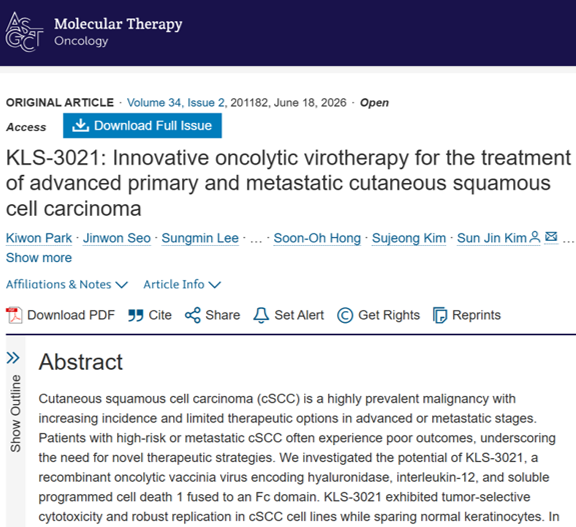
Kolon Life Science (CEO Lee Han-kook) announced on April 27 that the preclinical research results of KLS-3021, its anticancer gene therapy candidate, for cutaneous squamous cell carcinoma (cSCC) have been officially published in Molecular Therapy Oncology (IF 5.3), a highly authoritative international journal in the field of cell and gene therapy.
KLS-3021 is a next-generation oncolytic gene therapy candidate that loads therapeutic genes (PH-20, IL-12, and sPD1-Fc) onto a recombinant vaccinia virus engineered for enhanced cancer cell selectivity. It features a design that, in addition to the virus's direct oncolytic mechanism, degrades the extracellular matrix within the tumor to facilitate immune cell infiltration and induce an anticancer immune response.
According to the research results, KLS-3021 demonstrated higher cancer cell-selective cytotoxicity and viral replication capability in cSCC cell lines compared to normal cells. This showed the potential of the oncolytic vaccinia virus to induce additional therapeutic effects as it replicates inside the tumor, rather than merely attacking individual cancer cells.
Significant efficacy was also confirmed in a metastatic model. A single intratumoral administration into the primary tumor reduced the size of the primary tumor while simultaneously exhibiting tumor progression inhibition in lymph node metastatic lesions. Furthermore, the continuous spread of the virus within metastatic sites suggested that KLS-3021 could serve as an effective therapeutic strategy not only for localized tumors but also for metastatic lesions.
Modulations in the tumor microenvironment (TME) were observed as well. Histological analysis revealed hyaluronic acid degradation within the tumor microenvironment, widespread viral dissemination, increased immune cell infiltration, and immunogenic cell death (ICD). These findings demonstrate that KLS-3021 acts as a multifunctional therapeutic platform that goes beyond direct cell destruction to simultaneously dismantle both the physical and immunological barriers of the tumor microenvironment.
Advanced and metastatic cSCC is a disease with high unmet medical needs due to its limited treatment options. In this study, KLS-3021 presented a promising potential to address these critical clinical gaps. Furthermore, by formally publishing the research results in a peer-reviewed international journal rather than just delivering a conference presentation, the company has elevated its objective scientific validation to a higher tier.
Kolon Life Science is expanding the research scope of KLS-3021 beyond cSCC to include prostate cancer, head and neck squamous cell carcinoma (HNSCC), and triple-negative breast cancer (TNBC). The company strategy is to disclose these upcoming research results through peer-reviewed papers and conference presentations to leverage them in global joint development and technology transfer (L/O) discussions.
Lee Han-kook, CEO of Kolon Life Science, stated, “The publication in Molecular Therapy Oncology represents international recognition of the therapeutic potential exhibited by KLS-3021 in advanced and metastatic cutaneous squamous cell carcinoma.” He added, “We will continue to strengthen our academic validation, while further accelerating discussions on indication expansion and global commercialization.”





KOLON Group's mobile web is optimized for vertical screens.
