Kolon Life Science Unveils Head and Neck Cancer Data for the First Time at AACR
KOLON Life Science
2026.04.22

▶ Demonstrates significant antitumor efficacy and changes in tumor microenvironment with just a single administration
▶ Global presentation to researchers expected to expand potential for clinical development and commercialization linkages
Kolon Life Science (CEO Lee Han-kook) announced that it presented a poster on the preclinical research results of KLS-3021, its anticancer gene therapy candidate, for head and neck squamous cell carcinoma (HNSCC) at the American Association for Cancer Research (AACR 2026), held in San Diego, U.S., from April 17 to 22 (local time). This marks the first time that the research results of KLS-3021 for HNSCC have been disclosed externally.
In this HNSCC preclinical study, KLS-3021 demonstrated excellent antitumor efficacy regardless of PD-L1 expression levels. Furthermore, it proved its potential for development as a next-generation oncolytic immunotherapy by converting the tumor microenvironment into a favorable condition for anticancer immunity.
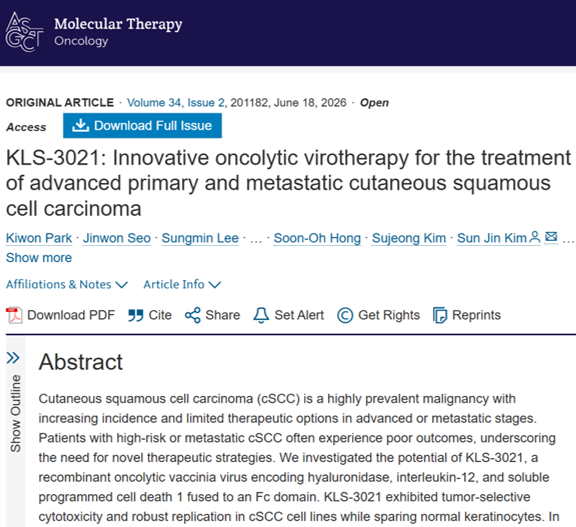
KLS-3021 is a next-generation anticancer gene therapy candidate that loads therapeutic genes (PH-20, IL-12, and sPD1-Fc) onto a recombinant vaccinia virus engineered for enhanced cancer cell selectivity. It features a design that, in addition to the virus's direct oncolytic mechanism, degrades the intratumoral stroma and induces an anticancer immune response.
In this study, KLS-3021 exhibited significant antitumor efficacy across various HNSCC orthotopic tumor models. Notably, in a high PD-L1 expression model (CPS≥1), a single intratumoral administration achieved superior tumor suppression effects compared to 'anti-PD-1', a standard immunotherapy, suggesting a novel therapeutic possibility for the patient group with high PD-L1 expression.
Moreover, even in a low PD-L1 expression model (CPS<1), KLS-3021 demonstrated distinct tumor regression compared to 'Cisplatin', a first-generation chemotherapeutic agent. This indicates the potential of KLS-3021 to deliver stable tumor treatment efficacy regardless of PD-L1 expression levels, serving as a rationale to expand the therapeutic scope to the low PD-L1 expression patient group, where response rates to conventional immunotherapies have been limited.
The mechanism altering the tumor microenvironment was also confirmed. KLS-3021 proved its differentiated mechanism compared to existing therapies by not only directly attacking the tumor but also shifting the tumor microenvironment to favor anticancer immunity. Following KLS-3021 administration, immune-cell-attracting signals, inflammatory responses, and T-cell infiltration and activation all increased, while immunosuppressive macrophage markers decreased.
In an animal model transplanted with human head and neck cancer, a single dose of KLS-3021 significantly lowered the tumor burden, and all subjects in the treatment group achieved long-term survival. The fact that consistent efficacy was confirmed in a model closely resembling the actual clinical tumor environment is evaluated as a result that further supports KLS-3021's potential for development as a treatment for head and neck cancer.
HNSCC is considered a cancer type with high unmet medical needs due to its high recurrence rate despite the existence of standard treatments such as surgery, radiation therapy, and chemotherapy. In particular, because clinical limitations restrict treatment options and response rates depending on PD-L1 expression levels, expectations for a new therapeutic approach are growing.
Based on these research results, Kolon Life Science plans to continuously strengthen its research on KLS-3021 in the HNSCC sector. In addition, through the AACR presentation, the company intends to promote KLS-3021's potential for development as an HNSCC treatment and its scalability as a next-generation oncolytic virus platform to global researchers. Currently, the company is concurrently conducting research on KLS-3021 for prostate cancer and triple-negative breast cancer (TNBC).
Lee Han-kook, CEO of Kolon Life Science, stated, “This AACR presentation is significant as KLS-3021 demonstrated efficacy independent of PD-L1 expression levels and shown its capability to modulate the tumor microenvironment in head and neck squamous cell carcinoma.” He added, “Moving forward, we plan to concretize our development strategies centering on cancer types with high unmet medical needs and initiate global R&D collaborations in earnest.”


KOLON Group's mobile web is optimized for vertical screens.
