▷ Kolon DACC Composite played a key role in the successful launch of Hanvit-TLV, the first private test launch vehicle in Korea, as a major parts supplier for propulsion systems
▷ Investments by Kolon affiliates represent a 17.7% of the total equity of Innospace.
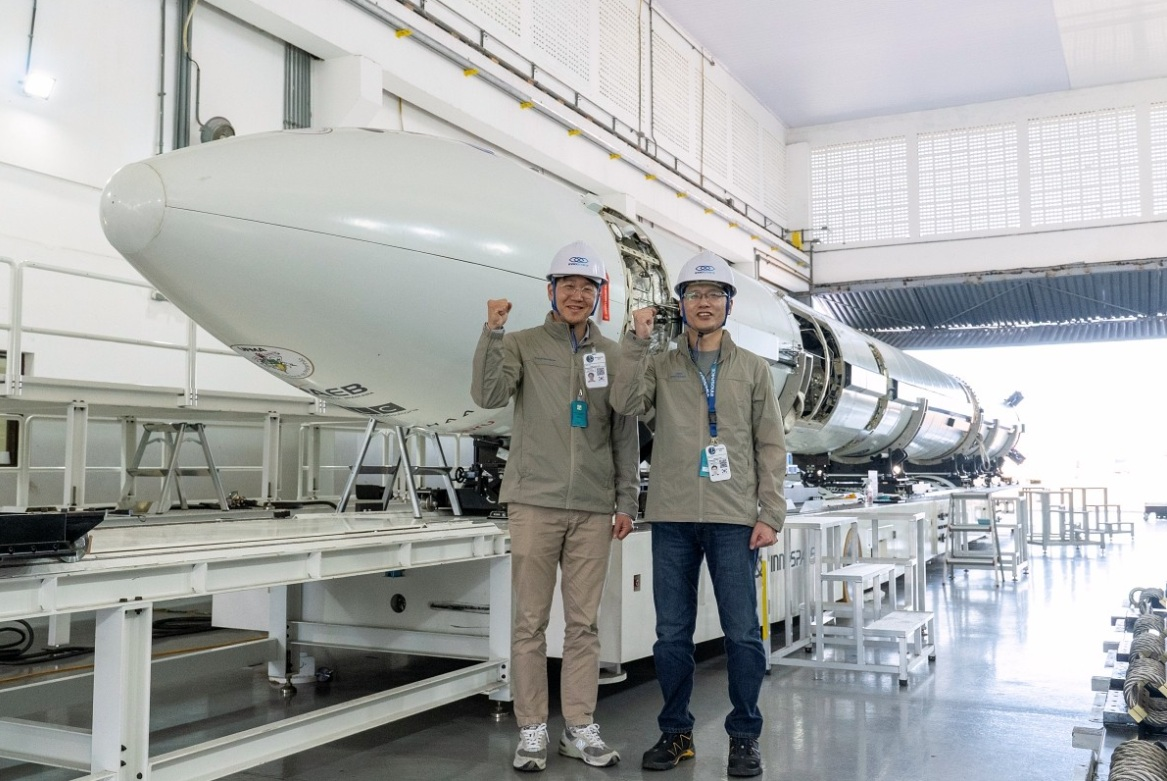
The Kolon Group's investment and participation in the space industry has reaped its first rewards. As news was reported that Korea's first private test launch vehicle, ‘Hanvit-TLV’, had been successfully launched from the Alcântara Launch Center in Brazil on the 21st (Korean time), Kolon’s proactive investment and technology for composite parts are attracting new attention.
It was revealed that three Kolon affiliates had played critical roles in the Hanvit-TLV launch project. Kolon DACC Composite, which specializes in composite parts and module manufacturing for aerospace, defense, and urban mobility, participated as a major component supplier, while Kolon Glotech was engaged as a strategic investor, and Kolon Investment as a financial investor.
A number of core components produced by Kolon DACC Composite based on its technology for developing ultra-lightweight, high heat-resistance composite parts were applied to this test launch vehicle. In particular, the company supplied a key component for the propulsion system that provides thrust for the launch vehicle to enter and remain in orbit. High-functional composite materials used in the propulsion system included a pressurized tank that stores high-pressure helium gas and nitrogen gas; a combustion chamber that stores the hybrid propellant and regulates the high-temperature, high-pressure combustion process; and a nozzle assembly which converts the combustion gases discharged at ultra-high temperatures and pressures into kinetic energy to generate thrust. In addition, a nose cone with high rigidity that protects payloads, such as a satellite mounted on top of the launch vehicle, was also manufactured and installed by Kolon DACC Composite.
The Kolon Group not only supplied components for the launch vehicle, but also invested in Innospace. Kolon Investment started with 1 billion won in 2019 and injected an additional 1 billion won the following year. In 2021, Kolon Glotech, an affiliate specializing in mobility materials and parts, invested 6 billion won, and Kolon Investment invested a further 2.8 billion won, raising the total investment by Kolon affiliates in Innospace to 10.8 billion won. This represents a 17.7% of the total equity of Innospace (as of March 2023), which is the largest among external investors.
Building on the success of the small test launcher, Kolon intends to step up its business activities in the private space industry. It plans to review continuous investments and expand its scope in the fields of domestic space development such as satellites, control systems, and communications.
The success of the test launch signals the opening of the private space sector in Korea. To date, spaceflight development has been led by the state only. Now with the capital and technology of private companies, the spaceflight market is expected to grow rapidly. Once the private sector takes hold, it is expected that not only will commercial satellites be launched into space more quickly and economically, but also the size of launch vehicles will be more diversified.
The global satellite launch vehicle market shows an annual average increase of 15.1%, and is estimated to reach around $29.6 billion by 2027. [Research & Market] So far, US SpaceX has launched 1,000 satellites weighing 400 kg, and plans to increase up to 12,000 in the future. More launches are planned. Global IT companies such as Amazon and Facebook are also planning to launch hundreds of small and medium-sized satellites. Recently, with the growing demand for small satellites weighing less than 500 kg for weather observation, communications, signal relay, and the Internet, the development of small launch vehicles has rapidly increased. In the past, most small satellites were launched using large rockets. Given the long production period and waiting time for launch, as well as a higher risk of failure of larger launch vehicles, the demand for rockets dedicated to small satellites has increased. Currently, about 40 companies across the world are working on small satellite launch vehicle services, and in Korea, startups such as Innospace are leading research and development in this field.


KOLON Group's mobile web is optimized for vertical screens.
